
What Is SEO Content? A Guide to Creating Content for SEO
- Phượng Trương Thị
- Nov 13, 2025
- 19 min read

Updated: Feb 2
Search engines reward content that is helpful, trustworthy, and aligned with what people are searching for. That’s why SEO content - content intentionally created to rank on Google is a core part of any digital marketing strategy.
So what is SEO content, really? In this guide, Venture Studios walks you through the different content types, how to craft them, and how to optimise each one for long-term traffic and conversions.

What Is SEO Content?
SEO content is any website content created specifically to rank well in search engines. It can include blog posts, product or service pages, landing pages, pillar pages, FAQs, and more. The goal is to match the terms and questions your customers are typing into Google (or other search engines) and provide valuable, relevant answers.

Well-written SEO content drives organic (unpaid) traffic to your site by meeting user intent, and it’s a cornerstone of any digital marketing strategy. In fact, appearing near the top of search results often means dramatically more clicks; studies show the #1 position on Google gets nearly 40% click-through rate.
For small businesses, ranking for relevant keywords can be a powerful way to attract new customers without paid ads.
How SEO Content Differs From Regular Content
Regular Content | SEO Content |
Written for general reading | Written to match search intent |
No structured keyword targeting | Uses keyword clusters + semantic topics |
May lack optimisation | Fully optimized (title, meta, headers, internal links) |
Random publishing | Planned through a content strategy/calendar |
May not rank | Designed specifically to rank on Google |
Why SEO Content Matters?

Creating SEO-friendly content matters because it taps into the demand that already exists. When someone searches for a solution your business provides (e.g. “best espresso machine for home” or “how to bake sourdough bread”), SEO-optimised pages increase the chance that person finds you.
Unlike social media posts that have a short life, a well-optimised blog post or page can continue driving traffic for months or years. As EditorNinja explains, “SEO content is marketing material produced to rank in search engines.” Its purpose is to capture existing search traffic and bring prospects to your site. Without it, many potential customers will never discover your business online.
Of course, good SEO content should still serve people first – it needs to be useful and well-written, not just a string of keywords.
When done right, SEO content builds your brand and helps grow your business naturally over time, forming a core part of how modern marketing teams operate including the broader scope covered in What Does a Digital Marketing Agency Do?
Main Types of SEO Content
Different page types can all be part of your SEO content strategy. Here are four common ones:
Blog Posts and Articles
Blog posts and articles are essential formats for SEO content. Both are designed to answer questions, educate readers, and attract search traffic—but they differ slightly in style. Blog posts are usually more casual and practical, while articles tend to be more detailed and research-driven.
Together, they help businesses reach users who are searching for information before making a purchase.
Examples of this type of SEO content include:
How-to guides
List-style posts
Beginner explanations
Trend or news updates
Step-by-step tutorials
Case studies and examples
By covering useful topics related to your products or services, blog posts and articles help capture top-of-funnel traffic—people who are still researching and comparing their options.
When done well, this content builds trust, showcases expertise, and positions your business as the helpful resource users return to.
Product or Service Pages
Product and service pages are the core of any commercial website, and they play a crucial role in SEO because they target users with strong purchase intent. These pages should clearly explain what you offer, who it’s for, and why it’s valuable—while also being optimised for the specific keywords people use when searching for that product or service.

Effective optimisation starts with using the right terms, such as the product name, category, features, benefits, and common variations (“women’s waterproof winter coat,” “CRM software for small businesses,” “affordable home cleaning service”). Clear, keyword-rich descriptions help search engines understand what the page is about and ensure it appears in front of ready-to-buy customers.
A key rule is to avoid duplicate content. Each product or service page must have its own unique copy, even if the variations seem small.
For example, if you sell a blue and a red version of the same shirt, each page should describe the colour, use cases, style details, and reasons someone might choose that version. Google can penalise identical product descriptions, which harms rankings across the entire site.
Well-written, persuasive product or service pages don’t just rank—they convert. By combining unique descriptions, keyword optimisation, clear benefits, and strong calls to action, these pages help turn searchers into customers at the moment they’re most ready to buy.
Pillar Pages / Topic Clusters
A pillar page is a comprehensive, long-form page covering a broad topic in depth. It usually links out to more focused “cluster” articles or subpages on related subtopics. For example, a digital agency might have a pillar page on “Website Design” that links to subpages on “UX Best Practices,” “Web Design Trends,” “How to Redesign a Website,” etc.
This structure (often called a topic cluster) signals to search engines that you have a strong topical authority.

Google’s own content guidelines recommend using topic clusters and linking related pages together. A pillar page lives high in your site hierarchy (like yoursite.com/topic/) and covers the main keyword in the title and headings. It should be high-quality, engaging, and link to all supporting pages to create a network that search engines understand as one big content hub.
Landing Pages
These are standalone pages often created for specific campaigns or geographic targets. Examples include a page for each brick-and-mortar store location, a page dedicated to a single service (like “SEO Marketing Services”), or a page tied to an online ad or email promotion. Landing pages are usually focused on conversion (getting the visitor to buy, sign up, or call).
Even so, you can optimise them for SEO by including keywords relevant to what visitors are looking for. For instance, a local dentist might have landing pages like “Family Dentist in Boston” or “Emergency Tooth Pain Relief.” GPO’s guide explains that any page – even an ad landing page – can and should be SEO-optimised if you want to drive organic traffic. This means using relevant keywords in the title, headers, and content, and making sure the page is crawlable and indexable by search engines.
Keyword Research: Finding the Right Terms

A good SEO content strategy always starts with keyword research. This means identifying the words and phrases your target customers use in search engines. A helpful definition from Ahrefs: “Keyword research is the process of discovering valuable search queries that your target customers type into search engines like Google”. In other words, don’t guess – look at the data.
Here’s how to do it:
Brainstorm Seed Keywords
Start your keyword research by creating a list of seed keywords—simple, broad terms directly related to your business, industry, or the problems your customers are trying to solve. These are the foundational phrases that help tools generate more specific keyword ideas later.
To do this effectively, step into your customer’s mindset. Think about what they would type into Google when they’re looking for your product or service. These don’t need to be perfect or highly targeted yet—they’re just the starting point.
Industry | Seed Keywords (Examples) |
Bakery | • Sourdough bread• Cupcake delivery• Birthday cakes near me• Gluten-free pastries |
Digital Marketing Agency | • Seo service• Google ads management• Content marketing |
Fitness Coach | • Weight loss training• Home workout plan• Personal trainer near me |
The goal is to list 5–15 simple ideas that reflect what you offer. These seed keywords will later expand into long-tail keywords, keyword clusters, and SEO content topics, giving you a strong foundation for your SEO strategy.
Use Keyword Research Tools
Enter your seed terms into keyword tools to get a long list of related ideas. There are free and paid options. Google Keyword Planner (for Ads) is free and shows search volumes if you have an account. Google Trends can show rising topics.

Tools like AnswerThePublic or AlsoAsked (free tier) will suggest common questions people search for.. For more depth, paid tools like Ahrefs, SEMrush, Moz Keyword Explorer, or KWFinder provide monthly search volume, keyword difficulty (how hard to rank), and even a list of related terms.

According to a Zapier review, great keyword tools give you traffic numbers, difficulty scores, and competitive analysis to know if you can realistically rank. For example, Ahrefs’ Keywords Explorer can take a seed term and generate hundreds of suggestions, even using AI to propose new ideas.
Analyse Search Intent
After gathering your potential keywords, the next step is to understand what users truly want when they search for each term. This is called search intent, and it’s one of the biggest ranking factors in modern SEO. Google rewards pages that match the exact purpose behind the search.
Types of Search Intent
Intent Type | What It Means | Example Keyword |
Informational | Users want to learn or understand something | “how to make espresso at home” |
Commercial | Users are comparing options before deciding | “best espresso machines 2025” |
Transactional | Users are ready to buy or take action | “buy espresso machine” |
Navigational | Users want a specific brand, page, or website | “DeLonghi official website” |
Understanding this helps you choose the right keywords for the right content format.For example:
A how-to guide should target informational keywords.
A product page should target transactional keywords.
A comparison article should target commercial keywords.

Matching intent properly makes ranking much easier because your content aligns with what Google expects to show on page one.
Check Competitors
Competitor research helps you understand what Google already rewards. Start by searching your target keywords and noticing what types of pages appear on page one—blog posts, product pages, reviews, or guides. This shows the content format and angle you should aim for.

Tools like Ahrefs or SEMrush make this even easier by revealing the keywords your competitors rank for, their top-performing pages, and gaps you haven’t covered yet. For example, Ahrefs’ Site Explorer can show that a competitor gets strong traffic from a post like “best gluten-free bread recipe.” That’s a signal that the topic has demand—and that you may want to create a similar (but more helpful and comprehensive) piece.
Competitor-Checking Steps
Step | What to Do | Purpose |
Search Your Keyword | Look at Google’s top results for your target keyword. | Understand what content type Google prefers (blogs, product pages, guides). |
Study Their Content | Review their titles, headings, and structure. | See what information they include and how they present it. |
Use SEO Tools | Check Ahrefs, SEMrush, or Moz for competitor keywords and top pages. | Discover what brings them traffic and which keywords they rank for. |
Identify Gaps | Find topics or keywords competitors cover but you don’t. | Spot opportunities for new or improved content. |
Create Something Better | Produce content that is clearer, more useful, or more in-depth. | Outperform competitors and increase ranking potential. |
Competitor analysis isn’t about copying. It’s about understanding the landscape, spotting opportunities, and producing content that outperforms what’s already ranking.ng gaps, and creating better, more valuable content that earns its place on Google.
Refine and Prioritise
From your research, you’ll have a big list of keywords. Now filter them by relevance, search volume, and difficulty. Pick a mix of short-tail (broad) and long-tail (niche) keywords. Long-tail keywords (e.g. “how to freeze sourdough starter”) often have less competition and can be very effective. Record metrics like monthly searches and KD (Keyword Difficulty) if available.
Then choose a few target keywords per page: typically one primary keyword and several secondary/related keywords.
For example, if your primary keyword is “best coffee beans”, secondary could be “coffee beans for espresso” and “top coffee roasters”. Many keyword tools help automate this. (Image: Ahrefs’ “Beginner’s Guide” uses a lab metaphor for keyword research.) Once you have chosen a keyword, the SEO tool will list “Matching Terms” or related keywords. You might get thousands of ideas – far more than you can use. That’s fine. The next step is to narrow down to the most relevant ones for your content.
Use Existing Data
If you already have a website, your best keyword ideas often come from your own data. Start with Google Search Console, which shows the exact queries people use to find your pages. These are real searches already sending traffic to your site—making them valuable opportunities to expand on.
Next, check Google Analytics to see which pages get the most organic visits. These pages already perform well, so updating or expanding them can help you rank for additional keywords and capture even more traffic.

By analysing what’s already working—your high-impression keywords, rising pages, and top performers—you can double down on existing wins instead of starting from scratch. This approach is faster, more effective, and aligned with how Google already views your site.
Organise Keywords into Topics
After collecting your keywords, group them into logical themes or topics. This helps you plan your content more strategically and ensures your website builds topical authority around a subject. For example, all keywords related to “espresso” — such as espresso beans, espresso machines, brewing methods, and recipes — can be grouped into one topic cluster.
Once your clusters are organised, you can create a pillar page that covers the main topic in depth (e.g., “Complete Guide to Espresso”) and then publish separate, focused articles for each subtopic. These supporting articles link back to the pillar page, forming a strong internal linking structure.
Google increasingly rewards sites that use this organised, topic-based approach. SEO platforms like HubSpot, Ahrefs, and Semrush also highlight topic clusters as a modern, effective framework for ranking multiple related keywords and improving the overall structure of your content.
Keyword Research Tools
If you would like support in SEO, here are some popular choices for small businesses:
Tool | Type | What It Helps With |
Google Keyword Planner | Free | Provides search volume estimates (especially useful if you run Google Ads). |
Google Trends | Free | Shows rising, seasonal, and long-term search trends. |
AnswerThePublic / AlsoAsked | Free tiers | Visualize real user questions and common search queries. |
Ahrefs / SEMrush / Moz / Ubersuggest / KWFinder | Paid (some with free trials) | Offer detailed keyword metrics: search volume, keyword difficulty, SERP analysis, competitor data. |
Google Search Console | Free | Reveals keywords your site already ranks for or gets impressions on. |
Google Autocomplete & Related Searches | Free | Provides keyword suggestions directly from Google's search behaviour. |
ChatGPT or Bard | Free / Informal | Useful for brainstorming topics; always verify search volume with real keyword tools. |
Structuring and Optimising Your Content
Once you have a target keyword or topic, it’s time to structure your content and apply on-page SEO best practices. This means designing your page so that it’s clear to both humans and search engines what it’s about, while making it easy to read.
Use Clear Headings (H1, H2, H3…)
Your page title (the <h1>) should contain the main keyword and immediately tell the reader what the page is about. Use H2s for major sections, H3s for subsections, etc. This hierarchical structure helps both readers and search bots understand the flow of your content. For example, if your blog post is titled “How to Train a Puppy”, your H2s might be “Crate Training Basics”, “Housebreaking Tips”, “Leash Training 101”, and so on.
Each heading can naturally include related keywords or synonyms (e.g. “puppy training tips”). While headings themselves are not a magic ranking factor, they break up text and improve readability, which Google rewards.
Optimise Title Tags and Meta Descriptions
The title tag (HTML <title>) is crucial – it’s the main title shown in Google results. Make it unique, concise (around 50–60 characters or ~600 pixels), and include your primary keyword near the beginning. For example: “Best Coffee Beans in 2025 – [Your Brand]”.
The meta description (a 150–160 character summary) doesn’t directly affect rankings, but it influences whether people click your result. Write a clear, compelling meta description that includes the keyword and a call to action. Example: “Learn how to choose the best coffee beans for espresso, drip, or French press. Expert tips and our top picks.” If you don’t write one, Google will generate a snippet from your page text, which may not be optimal.
Include Keywords Naturally
Use your primary keyword and natural variations of it early in your content, ideally within the first 100–150 words. Then weave in related terms throughout the article in a way that feels smooth and relevant. Modern SEO is less about exact keyword repetition and more about context, clarity, and topic coverage. Google can understand synonyms and semantic meaning, so focus on writing that answers the user’s intent rather than chasing keyword density.
Always prioritise readability. If adding a keyword makes a sentence sound forced or unnatural, leave it out. Google specifically warns against keyword stuffing and repetitive phrasing. High-quality, relevant content that flows naturally will always perform better than content overloaded with keywords.
Write Valuable Content
Aim for comprehensive coverage of the topic. High-quality SEO content is thorough and answers the user’s question fully. Use short paragraphs, bullet lists, numbered steps, and other formatting to make the text scannable. Include examples, anecdotes, or data to add depth. If possible, back up claims with credible references.
For example, rather than just saying “SEO content is important,” you might mention a stat about blog traffic or link to a case study. Google values original insights and usefulness.
Optimise Images and Media
Visuals make your content engaging. Add relevant images, infographics, or videos where appropriate. But each image should be properly optimised: use descriptive filenames and alt text. The alt text is an HTML attribute describing the image for screen readers (and helps Google understand it).
For instance, if you include a photo of a coffee cup, the alt might be “pour-over espresso in ceramic cup”. This helps accessibility and SEO. Also compress images so they load fast (slow pages hurt SEO and user experience). The Google SEO guide reminds us to place images near related text and use high-quality images.
Internal Linking
Internal linking is one of the simplest yet most powerful on-page SEO techniques. It involves linking to other relevant pages on your own website. This helps in two important ways:
SEO benefit | Internal links distribute authority (“link juice”) across your site, helping important pages rank better. |
User experience | They guide readers to related information, keeping them engaged longer and reducing bounce rate. |
For example, if you’re writing a blog post titled “Top 10 Camping Tents,” you might naturally link phrases like “best hiking gear” or “lightweight backpacks” to other pages that cover those topics. This creates a logical path for users to explore more of your content.
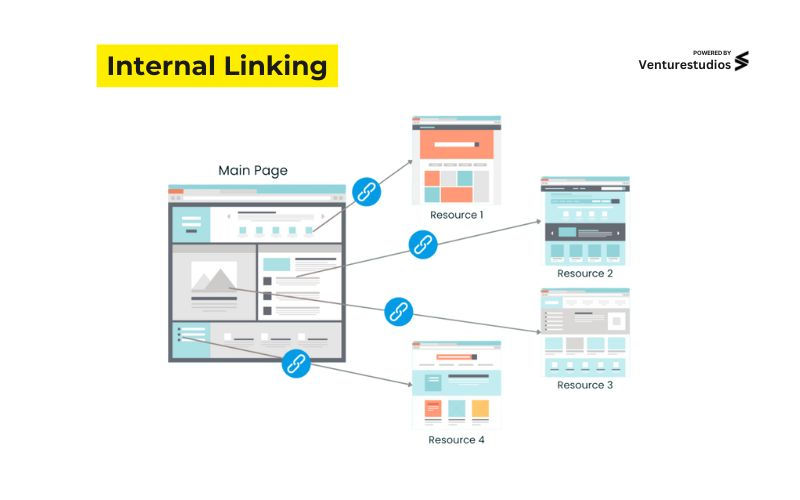
As noted in VentureStudio’s research, “clear page hierarchies and smart internal linking help users and search engines understand how your content fits together.” Strong internal linking supports topic clusters, improves site structure, and reinforces the relevance of your key pages.
Aim to include a few meaningful internal links on each page—preferably to content that expands on the topic. Always use descriptive anchor text, such as linking “espresso machines” directly to your espresso maker product page, so both Google and users immediately understand what the link leads to.
Clean URLs and Navigation
Your page’s URL should be short and include the keyword if possible (e.g. yoursite.com/best-coffee-beans rather than yoursite.com/post1234). Also ensure your site navigation and menu structure is intuitive. Google’s advice is to have a logical site hierarchy so important pages aren’t buried too deep.

If your content lives several clicks from the homepage, consider adding links on your homepage or main menu to keep it accessible. This aligns with how content clusters are meant to function: pillar pages at the top, related subpages linked from them.
Mobile and Technical Considerations
Make sure your pages load fast and work well on mobile devices – Google now primarily uses the mobile version of a page for ranking. Compress images, use a responsive design, and minimise pop-ups that hurt user experience. While these are technically driven factors, they directly influence how well your content performs. (For example, the Siteimprove guide notes that things like Core Web Vitals and mobile-friendliness affect rankings.)
By following these on-page practices, each piece of content is more likely to rank and keep visitors engaged. Remember: write for people first, then add in SEO elements. As one SEO expert put it, “the most effective SEO content reads as if it was written for humans first”.
Step-by-Step Guide to Creating SEO Content
Below is a simple workflow for creating an SEO-optimized piece of content from planning to publishing:
Define Your Topic and Goals: Decide what you want to achieve (e.g. attract new leads, answer customer FAQs, highlight a product). Identify a primary topic based on keyword research (see above).
For example, a local bakery might choose “how to make sourdough bread” if many people search that. Check that this topic fits your business goals and that there is search volume.
Do Keyword Research: Use the process described in the previous section to find the main keyword and a few related secondary keywords. Record their search volumes and difficulty. This research confirms that people are searching for your topic and helps you decide which angles to cover.
Create an Outline / Content Brief: Before writing, outline the structure of your article or page. Plan headings (H2s and H3s) and what each will cover. Use your keyword list to decide section titles. For instance, an article on “office coffee machine” might have H2s like “Types of Office Coffee Machines,” “Best Brands for Offices,” “Coffee Machine Maintenance Tips,” etc.
Also outline any images or charts you want to include. This brief helps ensure the writer (or you) doesn’t miss important points. (See example brief below.)
Write the Draft: Write your content with SEO in mind:
Title Creation | Craft a compelling title that includes the target keyword. |
Short Paragraphs | Use short, easy-to-read paragraphs (2–4 sentences). |
Natural Keyword Use | Include the keyword in the opening paragraph and naturally throughout the content. |
Secondary Keywords | Add related keywords or synonyms when introducing new ideas. |
Visual Elements | Use images, lists, or graphics to break up long text. |
Content Depth | Ensure the content fully answers the searcher’s question; aim for complete, clear coverage. |
Optimize On-Page Elements: After the draft is written, refine the SEO elements:
Meta Title & Description | Write unique metadata that includes the main keyword. |
Image Alt Text | Add descriptive, keyword-relevant alt text to all images. |
Headings | Ensure headings are clear and include relevant keywords. |
Internal Links | Link to other related pages on your site; add one high-quality external link if suitable. |
Keyword Placement | Include the main keyword (and a related term) in the first 100–150 words. |
Proofreading | Fix spelling, grammar, and factual errors to maintain trust and quality. |
SEO Tools | Use tools like Yoast SEO or SEMrush’s on-page checker for optimization feedback. |
Review & Approvals: Have someone else (editor, manager, or subject-matter expert) review the content to ensure it’s clear and error-free. Also confirm it aligns with brand voice and marketing goals.
Publish: Put the content live on your website. Ensure it’s placed in the right section of your site (e.g. under “Blog” or as a product page). Check technical settings: the URL is SEO-friendly, there are no “noindex” tags preventing crawling, and if you use a CMS plugin (like Yoast), that title and meta description fields are filled.
Promotion: After publishing, promote the content to help it gain traction. Share it on social media, mention it in newsletters, or link to it from other pages.
The Google guide notes that “promoting your new content will lead to faster discovery by both users and search engines”. The more people see and link to your content, the better its SEO performance.
Monitor Performance: Use Google Analytics and Google Search Console to track how the content is doing. Look at metrics like organic traffic, bounce rate, time on page, and search rankings.
Are people finding it, and does it keep them engaged? These insights tell you if you need to update or tweak the content. Siteimprove recommends tracking engagement and revisiting old content to keep it fresh.
Iterate and Update: SEO is not a set-it-and-forget-it process. Periodically update the content with new information or keywords if needed. If Google’s algorithm or user trends change, refreshing your post can help maintain or improve rankings.
Always treat content as “evergreen” – consider revising it at least once a year or whenever major changes occur in your industry.
Example Content Brief / Checklist: To keep everything organized, you can use a simple table or checklist for each content piece. Here’s a basic template:
Element | Example or Instruction |
Target Keyword | (Primary keyword or phrase, e.g. “best coffee beans”) |
Secondary Keywords | (Related terms, e.g. “organic coffee beans, coffee roasting”) |
Target Audience | (Who will read this? e.g. “Home coffee enthusiasts”) |
Page Type | (Blog post, product page, pillar page, etc.) |
Word Count Goal | (e.g. 1,200–1,500 words) |
Outline / Headings | (List planned H2/H3 titles or bullet points) |
Meta Title | (Draft title tag with keywords, < 60 chars) |
Meta Description | (Draft snippet, < 160 chars) |
Internal Links | (Other pages to link, e.g. “See our shop page on espresso machines.”) |
External Links | (Any authoritative sources to cite, e.g. industry reports) |
Images/Media | (Notes on charts or photos to include) |
Call to Action (CTA) | (What action should users take? e.g. “Contact us for a quote.”) |
This brief ensures a writer (or you) covers all bases. Flow Agency notes that key brief elements include specifying target/secondary keywords, the audience, content type, and word count. Use the brief to stay focused and avoid tangents.
Tools & Examples
There are many tools that can help at each step:
Category | Tools | Purpose |
Keyword Research | Google Keyword Planner, Google Trends, AnswerThePublic, AlsoAsked, Keywords Everywhere, SEMrush, Ahrefs, Ubersuggest, Moz | Find keyword ideas, search volume, and trending topics. |
Content Optimization | Yoast SEO, RankMath, Surfer SEO, Clearscope | Improve on-page SEO with suggestions, content scoring, and competitor analysis. |
Writing & Editing | Hemingway Editor, Grammarly, Google Docs, Microsoft Word | Write, edit, and refine content for readability and clarity. |
Monitoring & Tracking | Google Search Console, Google Analytics, Moz Pro, SEMrush Position Tracking | Track rankings, impressions, CTR, traffic behaviour, and page performance. |
Real-World Example: Imagine you own a small gym. A new post on your blog might be “Top 10 Exercises for Weight Loss.” You’d start by finding keywords like “exercises for weight loss” (informational intent) and maybe “gym near me weight loss” (local intent).
Your outline could include sections on cardio, strength training, and diet tips. After writing the article, you’d optimize the title (e.g. “Top 10 Weight Loss Exercises for Beginners”), add images of exercises with alt tags, and link to your membership page or related articles.
Over time, this post could rank and bring new visitors looking to get fit.
Another example: a local bakery might have a pillar page called “The Ultimate Bread-Making Guide”. It covers basics of bread, and links to cluster articles like “How to Make Sourdough at Home” or “Gluten-Free Baking Tips.”
This structure keeps readers clicking through your site and signals to Google that your bakery is an authority on bread (which can improve rankings for all those keywords).
FAQ
What exactly is SEO content?
It’s simply web content written and optimized to appear in search engine results. In other words, it’s content that addresses what people are searching for, using relevant keywords and good writing. SEO content includes blog articles, product pages, landing pages, or any page that’s crafted with search rankings in mind.
Why can’t I just write without keyword research?
You could, but you’d likely get little traffic. Keyword research ensures there is search demand for your topic. If you publish about something nobody searches for, nobody will find you. By researching keywords first, you write content that real people are actively looking for.
How long should an SEO blog post be?
There’s no fixed word count required. The important thing is to fully cover the topic. Longer articles (1000–2000+ words) often perform well because they can answer more questions and include more keywords naturally. But quality beats quantity: if you can answer the query thoroughly in 800 words, that can be enough. Just avoid fluff.
How often should I update my SEO content?
It’s good practice to review your content at least once a year. Update facts, add new insights, or improve the writing. Google favors fresh, accurate information. Even small updates (new data, a better image, clarifications) can help maintain or improve rankings over time.
How long until I see SEO results?
SEO isn’t instant. It can take weeks or months before you rank or see significant traffic changes. Search engines need time to crawl and index new pages, and then compare them to competitors. Be patient: continue adding high-quality content and promoting it, and results will grow over time.
Do I need to stuff keywords in my content?
No – in fact, stuffing (overusing) keywords can hurt you. Google discourages keyword stuffing as a spam tactic. Instead, use keywords naturally where they make sense: in headings, in the introduction, and in alt text for images. Focus on writing clearly and engagingly. Google’s algorithms now prioritize readability and user intent over exact keyword matches.
What’s the difference between SEO content and content marketing?
They overlap a lot. Content marketing is a broad strategy of using content to attract and engage customers. SEO content is specifically any of that content that’s optimized for search. In practice, good content marketing includes SEO content. For small businesses, writing valuable content with SEO in mind is both content marketing and SEO.


Comments